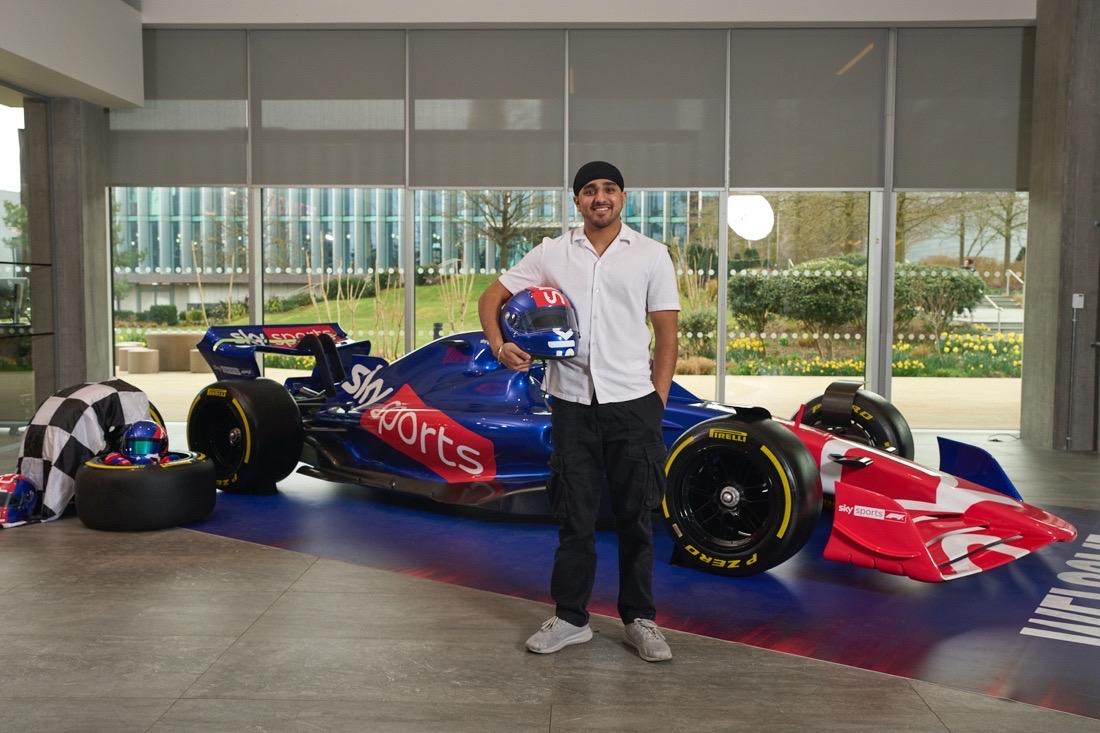
Software Engineer
Building production software at Sky.
Building production software at Sky.

BSc (Hons) Computer Science.

Player. Captain. Supporter. And content creator at Hayes Cricket Club.

Curious about the world and want to explore every little corner.
Good software starts with understanding the problem, not writing code. Complex problems should be broken into small, verifiable pieces, with real use cases driving the implementation. Tests should prove meaningful behaviour rather than chase coverage, and every change should be simple to understand, safe to evolve and observable in production.
Every piece of work should begin with a clear understanding of the problem being solved, the outcome that is needed and the boundaries around it. Implementation should come after that understanding, not before it.
Large problems should be decomposed into smaller, independently deliverable pieces. Each piece should be understandable, implementable and verifiable on its own so that complexity is reduced rather than carried forward.
Turn one difficult problem into several understandable ones.
For each smaller problem, behaviour tests should describe the outcome that needs to be achieved. They do not need to cover every possible scenario; their purpose is to prove that the problem being worked on has actually been solved.
Unit tests should be driven by real use cases rather than implementation details. Instead of testing every branch or if statement simply to increase coverage, the important question is what user or system scenario would actually cause the code to behave that way. If a meaningful scenario exists, it should be tested.
Don't ask: how do I test this branch? Ask: what use case gets me here?
Production code should exist to satisfy real, defined use cases. If the tests already describe everything the system currently needs to do, there is little value in adding speculative behaviour or complexity for problems that do not yet exist.
Why write code for a problem that does not exist?
Once the required behaviour is working, the implementation should be improved without changing what it does. Clearer names, simpler responsibilities, better abstractions, reduced duplication and more readable or efficient approaches all make the software easier to evolve.
Make it work. Then make the design better without changing what works.
After refactoring, the broader behaviour should be verified again. Unit tests protect the smaller use cases, while behaviour tests confirm that the original problem is still solved from the outside.
Automated tests provide confidence, but software should also be validated in the context in which it will actually be used. QA provides another layer of verification before a change reaches production.
Once the change has been validated, CI/CD should provide a repeatable and reliable path to production. Automated builds, tests and deployment checks help ensure that the same verified artefact progresses safely through each environment.
Production is where assumptions meet reality. Logs, metrics, traces and dashboards provide evidence of how the software actually behaves after release and help feed new information back into the next iteration.
Ship. Observe. Learn. Repeat.
AI & Software Engineering
Agentic development is already changing how software is built. Engineers can guide AI through tasks far faster than they could implement everything themselves. The important word, though, is guide.
Today, handing an AI a Jira ticket and simply saying "solve it" is not enough. It can lose context, make incorrect assumptions and drift away from the engineering process. It still needs an engineer to guide it - breaking down the problem, defining behaviours and use cases, reviewing its decisions and making sure the solution is actually something we should ship. That gap will undoubtedly get smaller as the technology improves.
But there is a bigger question: who takes responsibility? When something breaks in production, a P0 incident happens or the AI simply gets something wrong, somebody still needs to understand the system and take ownership of the outcome.
I can see software engineering moving towards a world where the engineer becomes the director and AI becomes the actor. The engineer understands the problem, sets the direction and takes responsibility; AI increasingly performs the implementation.
The uncomfortable part? You need far fewer directors than actors.
Principles guide the way I build software. These are the tools and technologies I use to put those principles into practice.
Languages I use across backend systems, artificial intelligence, data work and user-facing applications.
Building production APIs, reactive services and maintainable application boundaries.
Working with production services across cloud infrastructure and containerised deployment environments.
Connecting services reliably while managing resilience, performance and scale.
Turning behaviour, requirements and design intent into executable specifications.
Understanding production systems through traces, metrics, logs and measurable evidence.
Applying artificial intelligence, causal techniques and data-driven modelling to practical problems.
Creating accessible user interfaces for web applications, AI prototypes and Apple platforms.
Delivering software iteratively through collaborative development, code review and production release practices.
Tools evolve. Principles stay the same.